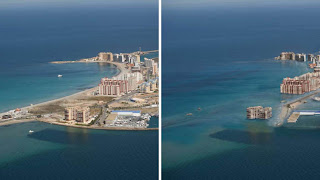
Imagine most of it under water and Kerans on one of the upper balconies...

These are the "high-ceilinged state rooms". In the novel the furniture has gone mouldy and snakes have moved in.
A luxury suite like the one described.
Just add dust, heat curtains and a radio buried under books.
How is the level of threat posed by nature to humans made clear on p.10-11?
(“A giant…” to “…a hundred yards away.”)
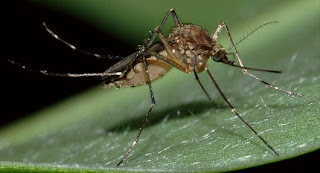
The mosquito is "the size of a dragon-fly"; as the day gets hotter the "huge predatory insects" are coming out of their "lairs", a word usually referring to the cave where a bear or wolves would live; the gymnosperms are described as "intruders" as they are prehistoric plants which don't belong in modern London; a "giant water-spider" appears in the lagoon.
Sounds just like a normal summer in Japan.
Page 12-13
What do we learn about the other people who have remained in the city?
Why have they stayed behind, and what condition are they in?
There are injured military personnel, people who don't want to leave their homes and the city they know, and pirates searching for whatever valuable things there are left.
Most people are in bad condition, whether mentally or physically - "either psychopaths or suffering from malnutrition and radiation sickness."
What information are we given about the soldiers and scientists traveling with the testing station? (Relationships, character, mission, physical condition etc).
Use your own words, supported by quotes from the text.
Riggs is technically the commander, but he and Kerans know each other well and have a simple, informal relationship ("without ceremony"). Riggs generally lets the others get on with their jobs however they want to ("in their own fashion").
Riggs acts like a strict military officer, but is "intelligent and sympathetic, and with a concealed reserve of droll humour."
The Scottish sergeant, Macready, isn't very friendly but gets his work done in a professional way (he is "a dour conscientious Scotsman").
The men are trying to keep an accurate map of the city and remove any survivors ("mapping the shifting keys and harbours and evacuating the last inhabitants") but they are not in good physical condition because of the climate and the drugs they have to take to protect them from disease ("their faces looked pinched and drawn", "continuous heat and the massive daily doses of antibiotics drained all energy from them").
Page 13-14
What details reveal the lagoon as a “garbage-filled swamp”?
The "terrible stench", the "sweet compacted smells of dead vegetation and rotting animal carcases" and the "huge flies".
The lagoon is full of decaying plants and animals which stink and attract giant flies.
What habit have the men developed?
Give examples from these pages and previously in the text.
They drink a lot of alcohol. Riggs often joins Kerans for "a few rounds of aperitif" (p.7) since Kerans' suite has a "cocktail bar stocked with... whiskies and brandies." On p.13, Riggs pretends he's going up to fix Kerans' water supply, but the others don't care since they all drink anyway - "Most of the men carried hip-flasks".

How would you summarize Kerans’ current relationship with the other members of the unit?
Use your own words, supported by quotes from the text.
Although Kerans has been working with the other men for a long time, "at least a couple of years", he has stopped speaking to them. Apart from Riggs and Macready, "he had spoken to none of them for six months."
Page 15-17
Why does Riggs say “all the work we’ve done has been a total waste”?
Look at both p.15 and p.17.
The water level is still rising, the temperature at the equator is up to 180 degrees, and the rain is getting heavier. The America and Russian teams are leaving because the situation is hopeless. On p.17 he says that the mapping they are doing is "absurd" and that they "should have got out years ago".
What news does Riggs give Kerans?
They are "packing up and leaving for good" in three days' time.
Why is Kerans disturbed by this news?
There is more than one reason.
Kerans has isolated himself from the other men and their misson; packing up and leaving will force him to rejoin the real world. He also enjoys having so much comfortable space to himself, which he will not have at the military camp in Greenland. He realises that he will have to start taking responsibility for other people again, and he may also realize that he will have to try and convince Beatrice to leave (see next question).
On p.16, what is the “problem” that Riggs and Kerans both refer to?
The problem is a woman called Beatrice who "refuses point-blank" to leave the city. Kerans knows that she "can be difficult sometimes" and is a "complex person", but because he has a connection with her Kerans is the one who has to talk her and get her to leave with them.
What details about the conditions and surroundings are given on p.16-17?
The rooms in the hotel are mouldy ("damp fungus-covered settees") and also inhabited by snakes. There is a reminder of the heat when they move from the hotel into the "boiling air", and the "voodoo jungle" seems strangely magical in a threatening way.
Why do you think Riggs asks Kerans “how do you sleep these days?"
(The answer to this is not yet clear, but some possibilities are that Riggs thinks Kerans is sleeping with Beatrice, that he is making a comment about Kerans' decision to stay at the hotel and not the testing station, or that he just wants to know how Kerans is doing generally.)

CREATIVE WRITING - THE RESCUE
You should now be working on your second piece of creative writing.
Here's the handout I gave you in class:
At the end of Chapter One, Kerans and Riggs set off on their patrol around the lagoons. You’re going to write a short scene in which they find one of the people who have stayed behind, as mentioned on p.12.
Riggs’ job is to evacuate these people and convince them to move to the settlement at Camp Byrd in Greenland. How would he do this? Some people would want to go, but some might not…
You should think about what kind of person they find – their physical and mental condition, their reason for staying behind, the place they would be sheltering in.
You should also refer to the dangers of the drowned city, and how the team would react to them.
Riggs and Kerans are not the only people on the patrol – Macready and some other men are also with them. What role do they have in the operation?
You should try to write in the same style as the novel, using the 3rd person (not I).
You should also keep the characters consistent with what you have seen of them so far.
The work will be graded on the quality of the scene, the consistency with the story, and the accuracy of the language.
You should write over 800 words.
The work is due on Tuesday 3oth.
CHAPTER 1 VOCAB LIST
These are the 20 words from chapter 1 you should know for your in-class vocab test.
Relentless, tangible, intolerable, sever, meticulous, momentous, lavish, melancholy, blemish, reluctant, introspective, misanthropy, malnutrition, recluse, conscientious, stench, serene, sceptical, temperament, synchronise.
You need to know the definition, and be able to form a sentence which shows the meaning of the word.
CHAPTER 2
Page 17-21
What is the effect of the passage in which a bat is eaten by an iguana?
Why does Chapter 2 start with this scene?
How does Ballard emphasize on p.18 that humans have lost their dominance?
Iguanas are "perched in the windows of the office blocks and department stores", places where people used to go about their everyday lives (this is juxtaposition). The iguanas are sitting in the boardrooms of companies, where the important people who used to run London's businesses would have sat, demonstrating that "the reptiles had taken over the city."
What reasons does Kerans have for being “indifferent” to the situation?
Look at p.19-21. There is more than one reason.
Kerans was born and raised in the far North, within the Arctic Circle, and has no experience of living in a major city. He doesn't feel the loss personally because of "this absence of personal memories"(p.20) of what they were like before. On the other hand, he has been through many of these drowned cities with Riggs and the team, has seen "an unending succession of green twilights" (p.19), and is therefore not disturbed by the decision to "abandon yet another city."
How is Dr. Bodkin contrasted with Kerans?
In what ways are they different?
Bodkin is older than Kerans and has memories of living in a city (we later learn he was born in London - see p.75), though even then they were already being slowly consumed by the rising waters.
Why are the cities of Bodkin’s childhood compared to “a discarded crown overgrown by wild orchids”(p.21)?
The crown represents man's achievement, both a crown and a city are symbols of status and importance (and are made from natural materials). The crown has been "overgrown" - consumed and defeated - by wild orchids, which are exotic and unusual flowers, just like the tropical jungle which has taken over London (though this is also dangerous...)
Page 23-27
What examples are there of the deterioration of the city and the team’s equipment on p.24?
The cruiser, Beatrice's boat, is "rusty" with "cracked and stained" windows, and is leaking oil. Inside her apartment building, the walls are damp and mouldy, and the elevator only works because of an emergency diesel motor.
How is Beatrice Dahl’s apartment contrasted with this state of decay?
Her apartment is clean, cool and shady, and is full of shiny objects: "the glint of cut-glass and silver", "a long chromium counter", "glasses and decanters reflected in a diamond-paned mirror."
The reader ‘sees’ Beatrice for the first time on p.25.
What does her description focus on?
What is the effect of this description?
Beatrice is lying in on a deck-chair in a bikini and wearing sunglasses, reading a magazine with an iced drink next to her. The image is one of luxury and relaxation. The description focuses on her physical attractiveness: her "long oiled body", "pink-tipped fingers", "smooth sleek face". The luxury and her physical condition are contrasted with the world outside her apartment (as on p.24) and the declining physical health of Kerans and the other members of the team. Compare this scene with Kerans' description on p.11.
What reasons does Riggs give Beatrice on p.26 to try and convince her to leave?
He points out that that the temperature is still going up and will reach 130 degrees; her fuel is running out; the heavy rain is moving north from the equator and after those clouds pass, it will be hot enough to boil water. Riggs then mentions the new giant mosquitoes (Type X Anopheles), the risk of skin cancer, the iguanas, and makes a reference to problems with sleeping (this is the second time he has made a comment like this - see p.17). On p.27 he also warns her about other survivors, the "human scavengers".
What relationship do Kerans and Beatrice seem to have?
How do they speak to each other?
They obviously know each other well (Kerans calls her "Bea") and have affection for each other, but there is some tension as well. Beatrice calls Kerans "good boy", patronising him to show that she won't take orders from him, and suggesting that her decision whether or not to stay is not connected to what Kerans does: "We?... I didn't know there was any chance of your staying behind?"
On p.27 when Beatrice doesn't seem to be worrying enough about the dangers around her, Kerans gets angry and shouts at her. This shows how concerned he is for her safety.
Page 27-30
How does Kerans and Beatrice's behaviour towards each other change after Riggs leaves?
They become more relaxed and affectionate. Kerans lies back in his chair and Beatrice brings him a drink (more alcohol...). She then sits next to him and leans against his knees. Kerans also puts his hand on her forehead, checking her temperature "like a child's" (p.28). This again shows his concern for her, and is an echo of her calling him a "good boy" on p.26, though the feeling here is very different.
What does Beatrice reveal about her sleeping habits?
She has had "peculiar nightmares recently", and she knows she isn't the only one - "A lot of people get them."(p.28)
Beatrice asks Kerans if he would join her if she decides to stay. What is his reply?
Kerans doesn't answer, he just says "Trying to tempt me, Bea? What a question." He then teases Beatrice, telling her that, yes, she's beautiful, but that doesn't mean anything because there's no-one else to compare her to. He says the situation is like Adam and Eve; Adam had no way of knowing if Eve was attractive. This is the second time he has thought of Adam and Eve - see p.23.
What happens to Kerans while he's in the apartment?
While listening to the "sombre" music in the background (Beethoven's 7th Symphony), Kerans looks at a painting by Max Ernst which belonged to Beatrice's grandfather. As he stares at the sun, he has a "curious feeling of memory and recognition" (p.29). Dr Bodkin explains his theory about these memories in Chapter 3.
The painting Kerans looks at may be this one, or something similar:

Would you want that on your wall?
Ernst often painted bizarre jungles, so it is easy to see the significance in the context of the novel.

Superman vs Doomsday
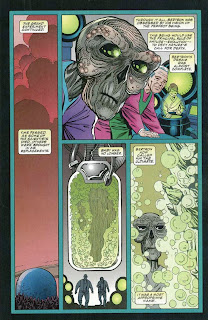
So we saw that Superman got beaten up and eventually killed by the monster called Doomsday, but the questions were - where did it come from, and how did it become so strong?
The explanation was a bit complicated, but basically Bertron (the alien scientist guy) set up an experiment on a dangerous planet full of savage creatures. He sent out a baby which died almost instantly, but Bertron collected the remains and cloned a new child again and again. Each time the child was recreated, it had evolved and adapted to survive the conditions and the monsters.
Eventually, this fast-track evolution created a total beast (Doomsday) that could survive on the planet and killed all the other creatures. It then broke into Bertron's lab and killed him - but why? Although Doomsday didn't know that Bertron had created it, and let it die thousands of times, somewhere in its genes it carried the memory of its past lives.
It therefore found Bertron and kicked his skull-faced alien ass.
The most important thing to remember in the context of The Drowned World is what the guy in red says on the last page - "Somehow the events of his past have gone beyond memory and become part of his genetic makeup!"
This is the same thing that is happening to Kerans, Beatrice and the others. The dreams they have are an echo from the ancient past. The idea is that humans carry memories from the distant past in their genes, and these memories are being awakened by the pehistoric conditions which have returned to the Earth.
Over the summer, you should read as far as the end of chapter 6 on p.81. That is just over one page per day, so you shouldn't have any problems. As you read, you should prepare for the 1st semester final exam. I have already given you the essay question, but here it is again:
There are three characters who choose to remain in the city: Kerans, Beatrice and Bodkin. Why does each of them stay behind? How well-equipped are they to survive? What do you think they will do next?
You will be able to use your text in the exam, so you should make notes in the book and highlight important sections of the novel. You also have to continue with your reading journals, writing one topic for each new chapter. As explained on your summer assignment handout, you can write about anything but there are some questions in the study guide I gave you which would make good journal topics.
To help you with the reading I will put vocab lists for each chapter on this page. You already have chapter 3, the others will be up soon. Because the lists are quite long, there is a separate post - D.W. Vocabulary. It's probably easier if you print out the lists, instead of having to look at the page each time you need them. You may need to copy and paste the list into a word document first.
I am not going to put the study guide questions on here - if there are any points you don't understand you should post a comment below.
Enjoy your summer!
READING JOURNAL
2. Why does Ballard describe the luxury of Kerans' hotel suite in so much detail?
3. Many of the remaining people in the city seem to have 'given up'.
Why do you think this is?
For the following journal topics (4-7), you have suggestions on the worksheets of good points to write about. You can also choose a different point, or write a general reaction to the chapter.
4. Write your reaction to, and interpretation of Chapter 3.
5. Write your reaction to, and interpretation of Chapter 4.
6. Write your reaction to, and interpretation of Chapter 5.
7. Write your reaction to, and interpretation of Chapter 6.